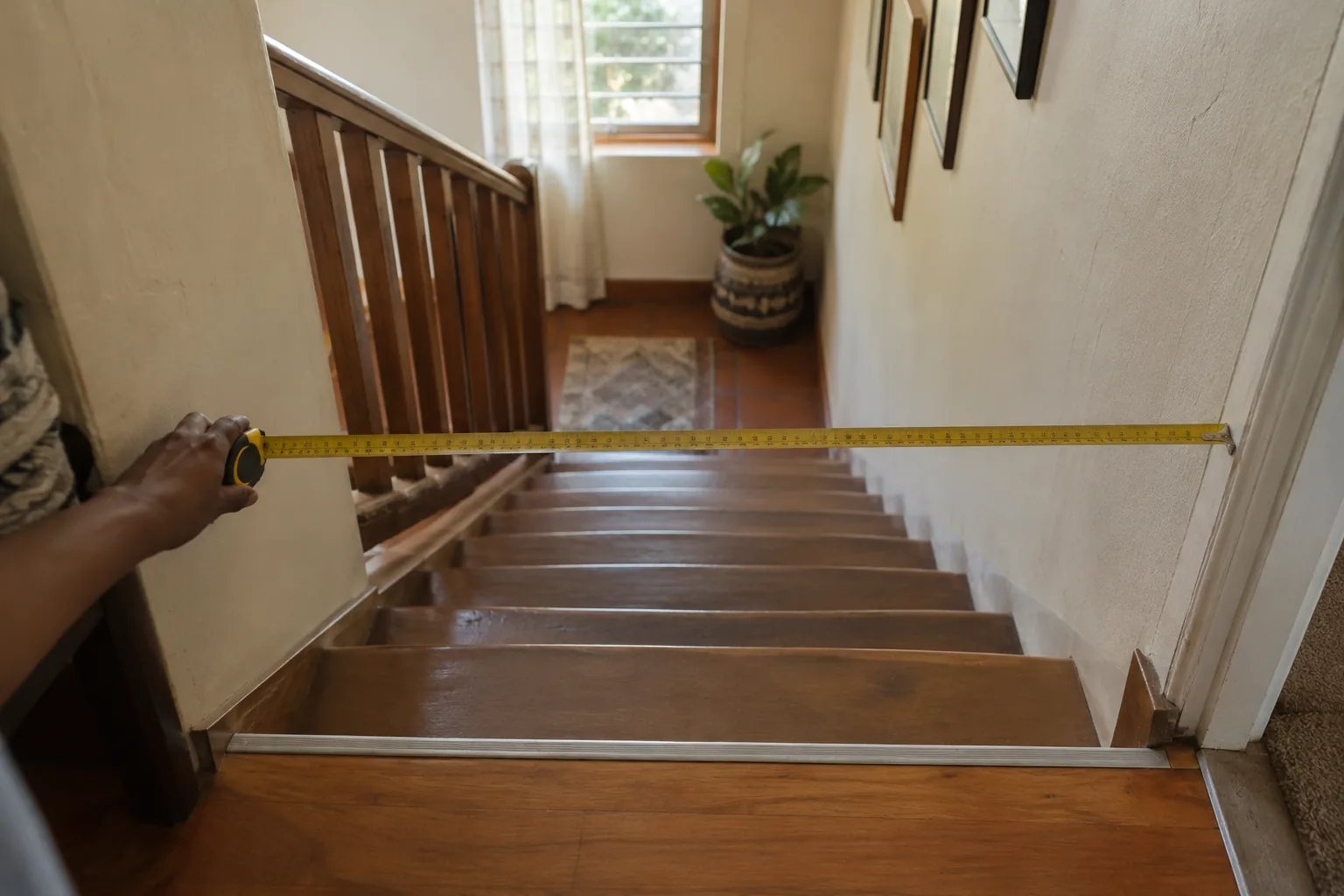
A stair lift is fixed to the stairs, and suppliers say it needs no structural change, though the width, condition and landings of your stairs still need checking. A home lift needs more: floor space on each level, a place for the lift to sit, and sometimes building work. You can check the basics yourself in about ten minutes, and a proper look at the home confirms the rest.
Start with the stairs
A stair lift lives on the staircase, so look at the stairs first.
- Straight or not. One flight with no turn is the simple case. A turn, a landing or two flights makes it a curved lift, with a rail made to measure.
- Width. Measure the width of the treads. A stair lift leaves less room to walk past, so it matters. We don't publish a minimum, because published figures are for specific models. One manufacturer's US page says 26 inches for its straight model, and that is no guide to yours.
- Parking space. Where can the chair fold up at the top and the bottom without blocking a door?
- A plug. A normal plug nearby for charging the battery.
- Inside or outside. Outdoor steps need an outdoor unit.
Suppliers say a stair lift is fixed to the treads, not the wall, and needs no structural change or major electrical work.
Then the space, for a home lift
A home lift needs a place to sit on every floor it serves.
- Floor space. One South African supplier publishes 0.8 square metres for a two-person shaftless lift and 1.3 square metres for a three-person one that carries a wheelchair. Another publishes a footprint of 1,047 by 810 mm for a two-person model.
- Stacked space. The lift needs the same spot on each floor, one above the other. Look for a cupboard, a corner of a room or a spot in the stairwell that lines up.
- Shaft or no shaft. Shaftless models say they need no shaft, pit or motor room. Enclosed platform lifts need a shaft and a shallow pit.
- Floors. More floors need a longer travel. One two-person model says 4.5 metres, and an enclosed platform lift 1.6 to 15 metres.
- Power. Suppliers say a normal 220V plug is enough for the shaftless models.
We don't publish a headroom figure, because we could not confirm one from a supplier page. Ask whoever quotes.
Building work, plans and permission
- Building work. A stair lift usually needs none. A home lift can need none, as with some freestanding models, or more, where a shaft, pit or new opening is needed.
- Plans. The lift regulations say a lift has to follow the national building regulations where they apply. We could not confirm from a source whether a home lift needs municipal plan approval. Ask your municipality or whoever quotes.
- Permission. If you rent or live in a complex or estate, check your landlord, body corporate or estate rules before any work.
The rules that apply once it's in
South African lift regulations apply to a lift in a private home. The owner has to have it examined and maintained by a competent lift service provider and inspected at intervals. See lift service and maintenance. Ask any installer who will do this and what it costs.
Questions people ask
Can any house have a stair lift?
It depends on the staircase. Straight stairs are the simple case, and curved stairs need a rail made to measure. Width, the condition of the treads and the landings all matter, so a look at the stairs confirms it.
Does a home lift need a shaft?
Some models say they don't. Freestanding shaftless lifts say they need no shaft, pit or motor room. Enclosed platform lifts do. Ask which kind you are being quoted.
Does a lift need building work?
A stair lift usually doesn't. A home lift can, depending on the type and the home. Ask for any building work to be listed and priced.
Do I need the municipality's permission?
We could not confirm this from a source. The regulations ask for compliance with the building regulations where they apply, so ask your municipality or whoever quotes.
What if I rent or live in a complex?
Check with your landlord, body corporate or estate before any work.
Sources for the figures and rules on this page
- A South African supplier: no shaft, pit or motor room, normal 220V plug, 0.8 square metres (two-person) and 1.3 square metres (three-person, most wheelchair models) (accessed 14 Nov 2026) lifta.co.za (opens in a new tab)
- Irish distributor: footprint 1047 by 810 mm, travel up to 4.5 metres (accessed 14 Nov 2026) stiltzlifts.ie (opens in a new tab)
- Manufacturer: enclosed platform lift, travel 1.6 to 15 metres, pit recessed 50 mm (accessed 14 Nov 2026) aritco.com (opens in a new tab)
- A stair lift supplier says no structural change is needed (accessed 14 Nov 2026) acornstairlifts.co.za (opens in a new tab)
- A South African supplier says the lift is fixed to the treads, not the wall, and no major electrical work is usually required (accessed 14 Nov 2026) stairliftchair.co.za (opens in a new tab)
- Manufacturer blog, US figure of at least 26 inches for a straight model (post dated 20 May 2026) acornstairlifts.com (opens in a new tab)
- Lift, Escalator and Passenger Conveyor Regulations 2009, regulation 4(1)(b) and the scope note (Government Gazette 39132, Notice R763, 28 Aug 2015) gov.za (opens in a new tab)